Radiant Net
RUSCHWOMAN
June 23rd — September 15th, 2024

Untitled, oil and acrylic on woven canvas on wooden stretchers, in four parts, 200cm x 160cm, 2024

Untitled, side view

Radiant Net, installation view, RUSCHWOMAN, Chicago
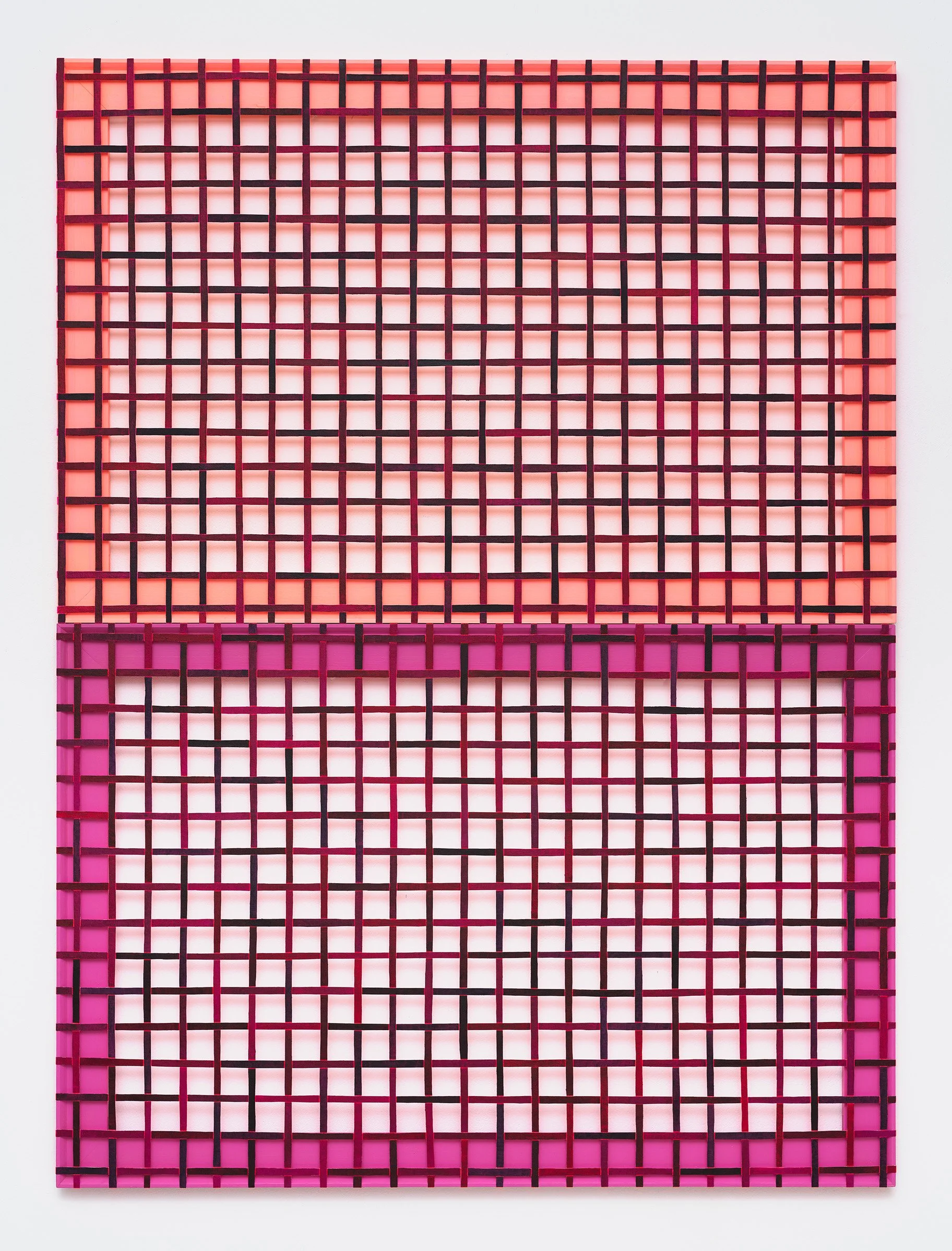
Untitled, oil and acrylic on woven canvas on wooden stretchers, in two parts, 160cm x 120cm, 2024

Radiant Net, installation view, RUSCHWOMAN, Chicago

Untitled, oil and acrylic on woven canvas and linen on wooden stretchers, in two parts, 160cm x 160cm, 2024

Untitled, side view
Over under around and through. Throughout the past decade Katy Kirbach’s approach to painting has fractured the medium’s singular operation within the realm of appearances, a rationalist’s protest to the easy equation of seeing being believing. Instead, Kirbach has resorted to a stratagem exercised by artists across two or three generations before her who tempered their commitments to formalism and total abstraction with ties to feminism and a liberatory politics that resists status quo power relations: a shift of attention down into the superstructures where elided labors, means of production, and marginalized subject positions may be scrutinized. For Kirbach’s practice this has meant a magnification and reenactment of the foundational structures of painting for time immemorial: the cloth upon which most paintings we know, are taught, remember, and appreciate depend. It’s even telling the persistence with which this base layer of painting is referred to almost exclusively as “canvas,” to divorce it from the broader associations of feminized domestic labor with the material reality of cloth. And more than only gendered aspersions to the craft of cloth-making, there is the persistent culturally embedded relationship between weaving and punishment following on Ovid’s tale of Athena sentencing Arachne to a life as a spider.
…
In Katy Kirbach’s newest works, subtle shifts in hue and tone across these facets are held aloft in the radiant nets of her open weaves. The warp and weft of the cloth from which the painting is constituted is imitated (also neatly dragged, deranged, and otherwise lovingly disrupted) in the all-over compositional structures of the canvas. There are several instances in which the canvas is constructed bit by bit from the mosaic-adjacent surfaces of painted points of overlap, and subsequently those canvases serve as units within a yet larger whole. Painting here is both reduced to a minimal set of tactics and exploded into endless permutations of complexity. At the scale of these marks and ideas, the patterns they evoke might be neurological, sociological, architectonic, or algorithmic—suspended between particle physics and the binarisms of widespread data collation.
- excerpt from the exhibition essay by Matt Morris